



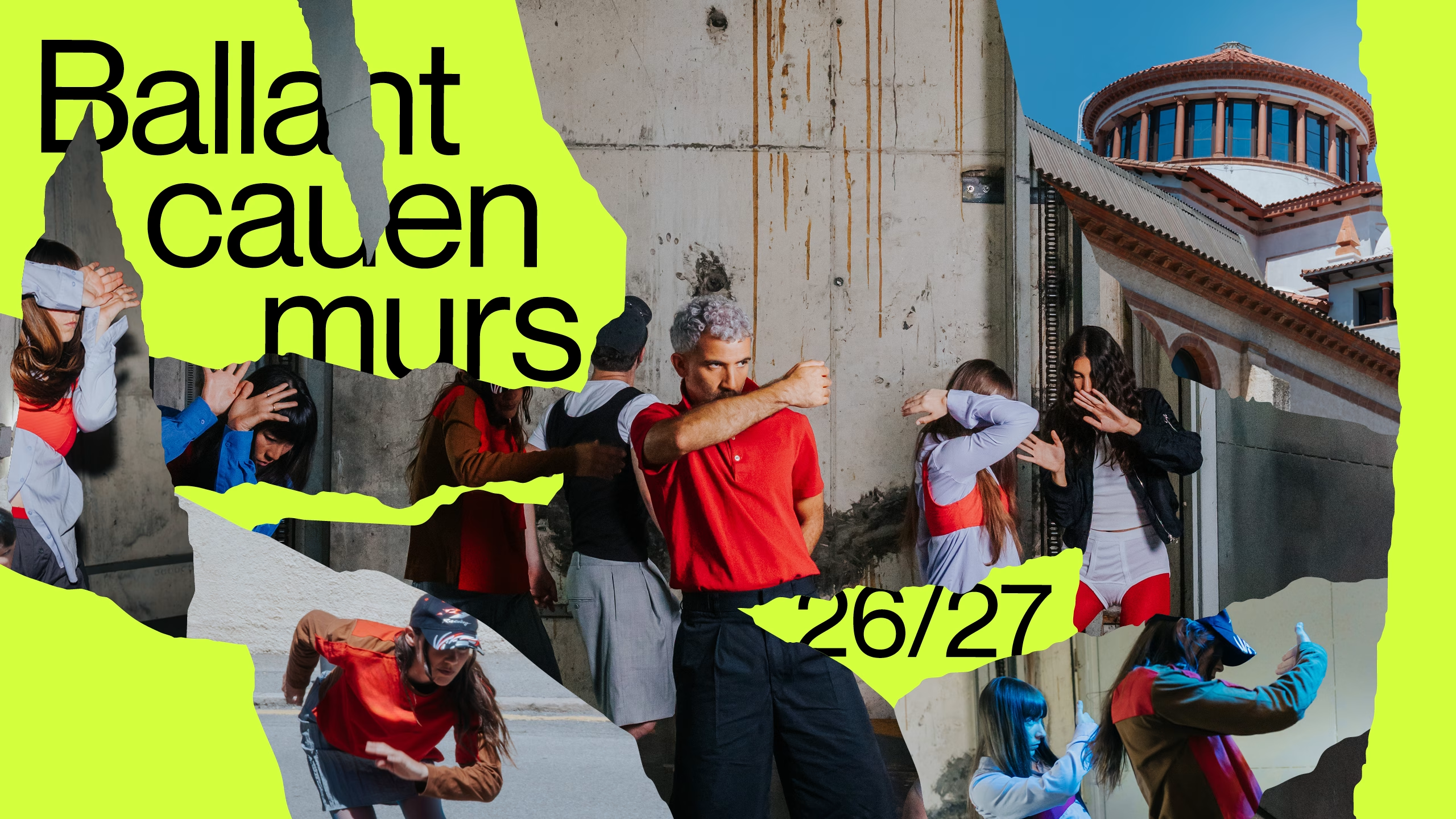
DANCING, WALLS FALL
With over twenty years’ experience, the Mercat de les Flors is the leading dance and movement arts institution in Catalonia. A place dedicated to supporting creation, promoting artists and disseminating dance among different audiences.
The Mercat is not just a theatre. It is a venue for creating, thinking about and sharing dance; a meeting place for artists, audiences and communities. It has played a key role in the development of dance in Catalonia for over two decades, promoting a living artistic ecosystem that not only contemplates dance as an artistic practice, but also as a source of knowledge, relationships and transformation.
The Mercat inaugurates a new phase with the 2026/2027 season. While the building is being refurbished, with its dance halls temporarily closed, the programming has been transferred to other venues around Barcelona and Catalonia. This move should not be seen as a mere interruption, but rather as an opportunity to imagine a Mercat without walls: more open, more permeable and more connected to the city, its communities and its landscapes.
This moment of transformation also coincides with the launch of the Mercat’s associated artists programme, a line of work aimed at strengthening the accompaniment offered to creators over time. Inka Romaní, Lorena Nogal, Guillem Jiménez and Candela Capitán belong to this first generation of associated artists, whose research and creations feature in the programming.
Under the slogan Dancing, walls fall, the programming poses a simple but urgent question: what walls do we need to tear down today?
Many of the walls that cut through the present day are built around the human body. We live in a time marked by new forms of surveillance, control and means of discipline. Bodies are observed, classified, exposed and subjected to multiple social, political and technological pressures. The creations of Candela Capitán, Núria Guiu, Guillem Jiménez, Ester Guntín and Lorena Nogal explore some of these contemporary tensions, revealing hyperexposed or monitored bodies, as well as bodies subjected to body-normativity or moulded by narratives of performance, image and technology. At the same time, artists such as Inka Romaní and Taiat Dansa remind us that these mechanisms have a past. Their works revisit the forms of control exercised over bodies during the Franco regime, and the patriarchal structures that Federico García Lorca denounced in his time, showing how many of these stratagems of power continue to be projected into the present. In all the pieces, the bodies are impacted by norms, expectations and systems of domination that condition our way of inhabiting the world and constructing our identity.
But these walls not only condition bodies: they also wear them down. Faced with the collective fatigue, uncertainty and sense of collapse that permeate our time, tired, turbulent, monstrous bodies appear or bodies in permanent transformation. The pieces by (La)Horde, Katerina Andreou, Marlene Monteiro Freitas, Ewa Dziarnowska and PSIRC reflect on this moment in which the structures that support the world as we know it are beginning to crumble. They are not only works haunted by the crisis, but also by the question of how to move forward when the old references are nowhere to be found, how to rebuild places of refuge and what forms of resistance are still possible. Their works imagine societies that dance to the point of exhaustion, landscapes that emerge after the catastrophe, rituals where chaos opens up new possibilities, spaces of shared attention and shelters built in the midst of uncertainty. These are proposals that remind us that, when the walls crack and the known world no longer can offer answers, dance continues to provide a means of imagining other ways of life.
The season also focuses on a third wall: the one that determines which identities, cultures and ways of life are accepted as legitimate. In a world where certain narratives continue to take the centre stage while others remain on the margins, the shows by Mette Ingvartsen, Jefta van Dinther, Alice Ripoll, Piny, Aina Lanas, Mamela Nyamza, Vanesa Aibar, Silvia Batet and the WAN collective, selected for the new Cèl·lula #7 programme, explore territories where identities remain open, cultures mix and traditions are transformed. They invite us to enter spaces where identity is unrestricted and where bodies experiment with other ways of being. Through ritual, memory, fiction, language, club culture, invisible genealogies and hybrid identities, these works vindicate the capacity to imagine other possible futures.
The programming for children, adolescents and families also has its share of the same questions that pervade this season. If part of the programming questions the mechanisms that condition our bodies, the barriers that separate us from others and the limits of our imagination, the shows by Anna Rubirola, Cécile Brousse and Manel Salas Palau, Marc Lacourt, Laura Alcalà, Animal Religion, Laura-Mireia-Dory, Montdedutor, AzkonaToloza and Roger Bernat invite us to tackle these questions from the standpoint of curiosity, play, discovery and shared experience. These are projects where the imagination is understood as a tool for transformation and that propose new forms of relationship between generations, bodies and communities.
These questions will also reach the classroom, at the hands of Roser López Espinosa, Quim Bigas and Aimar Pérez Galí, who persist in exploring dance as a pedagogical, creative and critical-thinking tool.
The season will be rounded out by the presence of festivals and platforms such as Sâlmon, IF and elPetit, which continue to enrich the artistic ecosystem of the Mercat and strengthen its vocation as a space open to experimentation, research and dialogue between disciplines, languages and different audiences.
Furthermore, this 2026/2027 season unfolds outside the Mercat. In conjunction with the Teatre Lliure, the Mercat will stage the works of Israel Galván and Mohamed El Khatib, María Muñoz and Amala Dianor. Additionally, it has co-programmed the new production of Crystal Pite and Kidd Pivot with the Gran Teatre del Liceu and it will present Sharon Eyal in collaboration with the Teatre Nacional de Catalunya. Apart from these proposals, projects conceived for other contexts and venues have been included, such as the collective artistic intervention by Aina Alegre at Montjuïc Castle, Pablo Lilienfeld & Federico Vladimir’s show at Barcelona’s municipal swimming pools, and Vero Cendoya’s project in Tarragona and Girona. We will also be offering a family programme prepared in collaboration with the SAT! Sant Andreu Teatre, which will feature Laura Alcalà and Ma Compagnie-Marc Lacourt.
This expansion marks the beginning of a new stage at the Mercat. Given the temporary closure of its dance halls for the next two years due to the need to refurbish the building, the institution begins a period of outside programming that transforms an exceptional circumstance into an opportunity to strengthen alliances, expand the presence of dance in the city and throughout Catalonia, and develop new ways for artists, audiences and communities to come together. Rather than a pause, this displacement inaugurates a network of artistic and institutional partnerships that will accompany the Mercat in the coming years, reaffirming its desire to continue operating as an open, permeable institution in constant movement.
In the coming years, dance will enter new spaces, find other audiences and develop new ways of coming together. Because the walls that we want to tear down are not only architectural. They are also the structures that subjugate the human body, the barriers that separate us from others and the limits that curb our imaginations. In the face of these walls, dance continues to be one of the most powerful forms of resistance, engagement and transformation.
María José Cifuentes (Director of the Mercat de les Flors)