






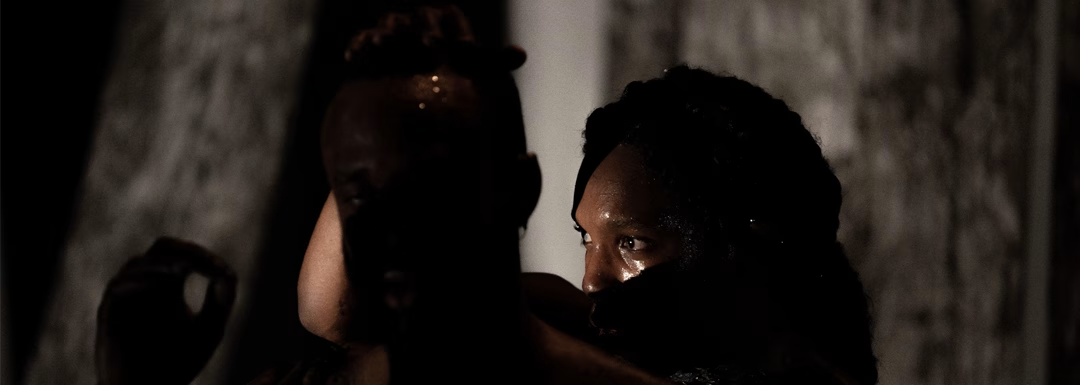
DARKMATTER invites the audience on a journey into a hidden world where posthumanist frameworks can be experienced on an embodied level. Cherish Menzo and Camilo Mejía Cortés transform and detach their bodies from socially conditioned movements, evolving toward a “new, (Afro)futuristic and enigmatic body”.
1. Your work shows a fascination for transformation and “embodiment” of different entities—what draws you to this idea of transgressing yourself on stage?
For DARKMATTER, the first pillar or “playground” I explored was post-humanism. As you mentioned, it was a space to speculate about images around the body and performativity. Post-humanism became a lens to dwell in. Initially, I approached it through Western Europeanframeworks, particularly concepts like the Anthropocene, which are heavily Western-centric. This made me reflect on how these ideas relate to diasporic or Afro-diasporic bodies.
Before leaning fully into Afro-futurism, I encountered the research of Philip Butler, who interrogates Black post-humanism. This offered a compelling framework to contrast with the earlier Western-centric references. Within African, Caribbean, Indigenous, and First Nation practices, the Anthropocene or the “human” is not always the central lens, so post-humanism can be observed in rituals and practices already present in these cultures.
Afro-futurism then offered a more concrete set of references, visible in literature, music, and film. It allowed me to explore multiple futuristic narratives rooted in the Black African and diasporic body, expanding possibilities for imagining futures.
Ultimately, this work frames the body as constantly performing matter, which ties directly to the play’s title, DARKMATTER. In the performance, audiences can experience the materiality and presence of matter itself, emphasizing both conceptual and embodied dimensions.
2. How does thinking of the body as a constantly transforming material influence your artistic practice, particularly in this work? Also, regarding the title, why DARKMATTER with the first part strikethrough:? Could you explain how it relates to the idea of a body as constantly performing and transforming matter?
I think when I create works, I often arrive at the title very early, because titles generate speculation and imagination. DARKMATTER is the second work in a trilogy, which doesn’t follow a chronological or linear storytelling structure, but it centralizes the Black body, particularly the Black diasporic body.
Before DARKMATTER, I created Jezebel, a solo performance engaging with collective narratives from late ’90s and early 2000s hip-hop and pop videos. I wanted to move beyond familiar images that often perpetuate stereotypes and find a more imaginative space. I wanted to distort narratives, challenge the spectator’s gaze, and explore the performing body in new ways—its relation to images, perception, and presence.
In relation to post-humanism and Afro-futurism, the notion of DARKMATTER refers to material that exists among us, may pass through us, but is not optically visible. It plays with visibility and invisibility, offering a space to speculate on how the Black body exists, moves, and matters. For myself, for Camilo Mejía Cortez, and for the artistic team, it became a way to dive into that materiality and presence.
The strikethrough on “Dark” is intentional. I didn’t want to call it Black Matter, which would feel too literal. Striking through “Dark” emphasizes matter itself—how things can matter, how one can matter, or even how one can be matter. At the same time, it plays with the tension around “dark,” provoking questions about darkness as a concept and its relation to skin tone. So, the title became a speculative space—a way to engage with readings of Black bodies, explore their materiality, and make the invisible visible, creating friction that challenges audiences to reconsider their relationship to both matter and narrative.
3. You mentioned your stage partner, Camilo Mejía Cortés, and this performance is a duet. You also mentioned wanting to open your research into a more collective story—what does collectivity mean in this context?
Working with Camilo is a real pleasure, and for me, this collaboration goes beyond the performance itself. I feel it’s important, especially when exploring certain themes, that the work does not come solely through a singular lens.
Collectivity, in this context, is about the relationship between the singular and the collective. It’s not about erasing individuality within a group, but rather allowing the singular to exist alongside the collective, and observing what dynamics and nuances emerge from that interaction. This includes differences in our backgrounds, how we relate to the body, performativity, and even concepts like the “black box” we explore in the work. These nuances enrich the storytelling, and collectivity extends beyond just Camilo and myself. It encompasses the entire artistic team—from lighting and scenography to sound design. All of these elements are active participants in the performance; they are as much “performers” as we are. For me, it’s an ecosystem of collaboration. Sound, light, and other materials are not merely supportive; they enter into a dialogue with the performers, shaping the work through negotiation and interaction. This approach emphasizes interconnectedness and shared responsibility, which is central to the idea of collectivity in DARKMATTER.
4. You mentioned the chopped and screwed technique—a musical process that slows down and stretches time. I think the experience of this affective space in Dark Matter really hinges on form and time. What excites you about translating a musical process like this into the body? How does it influence the intensity and rhythm of the performance?
Before coming to the Academy here in Amsterdam, my background was in hip-hop, house dance, and sonic practices that predated more institutionalized or formal dance styles. So, sound and music have always been fascinating to me, particularly in how they relate to image-making and narrative construction. Growing up, music videos played a huge role—they shaped how I thought about storytelling through both image and movement.
That’s why translating sound into physicality feels so compelling. The work with the chopped and screwed technique—slowing down and stretching time—first came out of my research in JEZEBEL. I was already exploring images and narratives that repeated certain tropes, asking questions like: Do we agree with them? Do we resist them? The technique became a tool for distortion, allowing me to glitch or twist readings while still keeping the original material recognizable. It emphasizes listening and reading, but also creates space to reinterpret and transform.
With chopped and screwed music, the tempo slows to around 60–70 beats per minute, and lyrics are pitched down, bringing the text and voice to the foreground over rhythm. I didn’t follow the beats literally in movement, but the concept of slowing, stretching, and expanding tissue and time influenced the physicality of the performance. It comes from hip-hop and rap, but the principle—foregrounding certain elements, emphasizing stillness, vulnerability, and openness—translates beautifully to the body.
In DARKMATTER, this approach allows the performance to balance power and intensity with stillness and quietness, creating moments where the body can both express and absorb, much like the music does for the ear.
5. Your work aims to estrange both the viewer and yourself from what we think we know—what role does discomfort play in your performances? Do you see alienation as a political tool, an emotional experience, or both?
I see alienation as absolutely political, though I wouldn’t reduce it to just a “tool.” It creates a political space by questioning and startling norms, forcing us to reflect on who is included in these norms, who is excluded, and why. It makes us confront what we repress, what we desire, what we demonize, and what we fetishize.
At the same time, alienation can dwell in the mystical, otherworldly, or fantastical. But bringing it into the here and now, into the real world, reminds us that alienation has historically been used both violently and creatively—sometimes to exclude, sometimes to escape dominant narratives and create space for fugitivity or alternative ways of being.
I don’t aim to make the audience uncomfortable for its own sake. Rather, I’m interested in creating a space that subtly challenges conventional expectations of performance and theatre. Traditionally, the audience is static, seated, observing, and performers give. I want to unsettle that relationship without explicitly telling anyone how to engage. This negotiation—between performers, audience, and the space—creates a sense of elasticity in the gaze and fosters awareness of relational dynamics.
Discomfort arises from this negotiation. The audience must consider their agency: how they lean in, what point of view they take, and whether they maintain their preexisting assumptions. By challenging the sense of a “fourth wall,” the performance makes uncomfortability productive, creating space for reflection, responsibility, and engagement rather than passive observation.
Christina Schmutz
BIBLIOGRAPHY:
Butler, Judith (1997). Excitable Speech. A Politics of the Performative. New York / London: Routledge.
Barad, Karen (2017). “What Flashes Up: Theological-Political-Scientific Fragments”. A: Keller, Catherine; Rubenstein, Marie-Jane (eds.), Entangled Worlds: Religion, Science, and New Materialisms. New York: Fordham University Press, 21–88.
Barad, Karen (2003). “Posthumanist Performativity: Toward an Understanding of How Matter Comes to Matter”. Signs, 28(3). Chicago.
Braidotti, Rosi (2022). Feminisme posthumà. Barcelona.
Chakrabarty, Dipesh (2009). “The Climate of History: Four Theses”. Critical Inquiry, 35(2).
Derrida, Jacques (1998). Políticas de la amistad. Madrid: Trotta.
Diéguez, Ileana (2007). Escenarios liminales: Teatralidades, performances y política. Buenos Aires: Atuel.
Faucheret, Anne; Kaup-Hasler, Veronica; Kirsch, Kira; Peternell, Andreas R.; Rainer, Johanna (eds.) (2014). Truth is Concrete: A Handbook for Artistic Strategies in Real Politics. Berlín.
Garrard, Greg et al. (2014). “Introduction: Imagining Anew: Challenges of Representing the Anthropocene”. Environmental Humanities, 5.
Haraway, Donna (1988).“Situated Knowledges: The Science Question in Feminism and the Privilege of Partial Perspective”. Feminist Studies, 14(3).
Kondo, Dorinne (2018). Worldmaking: Race, Performance and the Work of Creativity. Durham: Duke University Press.